Representational Entanglement
Hallucinations of Artificial Intelligence #
One of the most enigmatic concepts in modern physics is quantum entanglement. It describes a state where two or more particles, created simultaneously and interacting, merging their wave functions, establish an unseen, powerful, and unwavering bond, regardless of their physical separation. The striking aspect of this phenomenon is that this strong connection means any change in the state of one particle instantly and precisely determines the state of the other, even if they are at opposite ends of the visible universe.
This dynamic challenges our conventional understanding of causality. Moreover, if we take the cosmological model of the Big Bang as given, the initial co-creation of all the fundamental building blocks of matter leaves open the possibility of a deeper, fundamental connectivity among everything that constitutes the universe, regardless of their current distance.
In recent years, a phenomenon with similar logic has emerged in the field of artificial intelligence, specifically within neural networks. It's called representational entanglement and describes the peculiar connection that develops between the representations constructed by the AI. These representations can correspond to a physical object, a scenario, an abstract concept, or anything expressible through language.
The consequence is that any modification to one of these internal representations can unexpectedly affect the function and meaning of other representations within the neural network. This occurs even when these representations are considered semantically distant, that is, unrelated to each other.
Imagine an AI model trained to identify professions or specialties by analyzing images. Early in its training, the model hasn't yet recognized the difference between a cook in an apron and a doctor with a stethoscope. The two representations are entangled; the model groups anyone depicted relating to either profession into a single vague representational encompassing both roles, confusing their distinguishing characteristics. For the model at this stage, the cook is a doctor, and the doctor is a cook. Due to the entanglement, every new association the model learns during training concerning one profession is added to the joint representation, simultaneously distorting the meaning of the other, ultimately creating a mutually distorted semantic field.
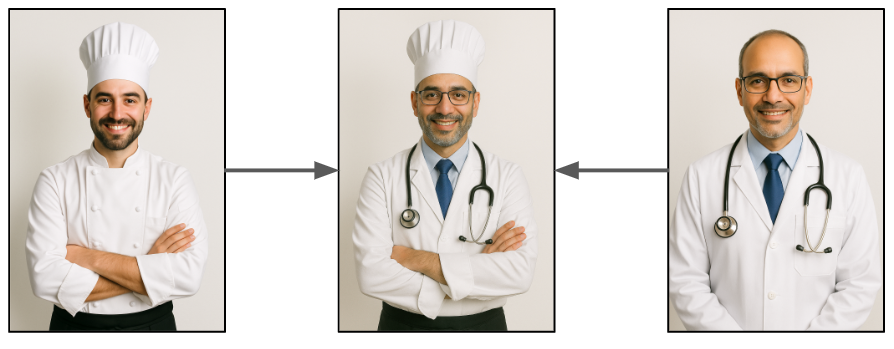
The erroneous predictions and classifications will continue until the model manages to form clear, distinct categories from the unified representation. Essentially, the critical semantic distance between the two concepts will be achieved when the necessary connecting tissue develops: linking the representation of the word "cook" to the perceptual and functional schema of a person wearing an apron, along with the skills and emotional states surrounding cooking, and, simultaneously, linking the representation of the word "doctor" to the stethoscope, the clinical environment, and the provision of medical care. Only when the neural network builds these distinct clusters of information will each concept secure its own space on the model's internal map without overlapping.
To clarify the extent of representational entanglement, let's turn our attention to the phenomenon's manifestation in Large Language Models (LLMs), models aimed at generating text by simulating human thought. Early in the training of such a model, the word "key" in its representational space might simultaneously refer to the metallic object that unlocks doors, the G-clef (musical key), and the metaphorical "key to success". Due to representational entanglement, these different meanings share overlapping coordinates in the high-dimensional space of the model's word vectors. That is, the different meanings are encoded very close to one another. The result is the leakage of elements from one vector to the other, with a direct impact on the model's function: the user might focus on one meaning (e.g., the key as an object), but the AI responds by confusing it with another (e.g., the musical key).
Gradually, and as the model receives appropriate training, its representations begin to restructure as the system learns to separate the meanings of the same word based on the context. Specifically, through repeated exposure to data and the optimization of its parameters, the word weights are rearranged and the related vectors gain distance. The model then recognizes that the word "key" accompanying words like "door" or "lock" belongs to a different semantic field than the one associated with "music" or "success". Consequently, the different concepts acquire distinct positions in the representational space, forming independent symbols, the physical, the musical, and the metaphorical, which are not confused but activated according to the context in which they appear.
This difference becomes apparent in the sentences constructed by the language model:
In the first case, where representational entanglement is observed (on the left), the sentence reveals that the concepts remain so tightly connected that characteristics from the metaphorical key are confused with the material properties of the physical key and the role of the musical clef. The result is content where the boundaries between meanings have fractured.
Conversely, in the case where the appropriate distance between representations has been achieved, the model has mastered the use of figurative language. The "key" is activated only concerning one selected property, e.g., "the key to success like a physical key that unlocks new horizons", functioning symbolically rather than as a literal object. With gradual optimization, the internal structures are rearranged, the distances between them are finalized, and distinct representations emerge from the fluid mass of representational entanglement.
Representational entanglement may not always be visible or easily detectable through simple analyses of the representational space, especially if the entangled concepts do not have a clear or stable external world reference. However, its presence can be indirectly revealed by the behavior of the language model, which may produce answers that, although syntactically and grammatically correct, are not entirely related to the meaning or intent of the question asked. The result is that the answers appear relevant but exude a subtle deviation from the expected, as if the model is attempting to capture a meaning that hasn't yet been fully disentangled from its other semantic roots.
These are the well-known AI hallucinations, an inevitable by-product of modern large language models. They usually arise from complex interactions between the model's architecture, training data, and optimization processes. In every hallucination, however, a deeper structural problem is observed, related to the system's failure to maintain distinct boundaries between the representations it constructs.
Given that the architecture of artificial neural networks attempts to simulate the brain's neural processes, the following question arises: Can the hallucinations produced by large language models assist us in understanding the hallucinations experienced by humans, for example, in relation to a psychotic state?
Psychotic States #
Psychotic states are disorders in which the individual partially or completely loses the ability to distinguish between subjective (internal) experience and objective (external) reality. Thoughts, sensations, and emotions cease to maintain their normal coherence, leading to phenomena like delusions (false beliefs held with absolute certainty) and hallucinations (sensory experiences without the corresponding external stimulus).
Understanding the psychotic experience is a challenge for the non-psychotic mind, which experiences a stable order in daily life, with elements emerging in a predictable and, to some extent, controllable manner. We know what to expect, and to a point, our reactions to most stimuli are familiar, while the structure of experience remains relatively cohesive. Conversely, in psychosis, this fundamental order of cohesive experience dissolves.
To help clarify the distinction between the two experiences, we will use the following narrative:
The cat showed no hurry. Each step was measured, full of self-assurance, as it observed the world around it as if possessing a wisdom of a thousand years.
A passerby stopped, watching its discreet movement, wondering what it might be seeing, what secrets its silence concealed. As he briefly sank into these thoughts, his attention was finally drawn elsewhere: the cat's shadow, which magnified with every step, making its body resemble an ethereal, mythical form. The passerby suddenly felt a shiver. This imposing silhouette on the wall reminded him, for a few seconds, of the shape of a lion. His mind immediately traveled to the mythical monsters of Greek mythology he once read about, which, according to legend, were composites of different animals. The Chimera had the body of a goat and a tail that ended in a snake. The Sphinx had the body of a lion and the head of a woman.
Realizing that time had passed, the passerby jolted himself and continued on his way. He left the cat behind, his mind now focused on his plans for the rest of the day.
The enigmatic nature of the cat and the shadow on the wall evoke mythical archetypes in the passerby. Although the thoughts emerge spontaneously, the observer's mind is not caught by surprise; it maintains a distance from the phantasmagoric representations, holding onto its psychological composure. He recognizes that the shadow is a simple physical reflection and the archetypal figures that arose exist only in myth, with no real correspondence in external reality. Consequently, the boundary between true representation and imaginary interpretation remains intact, and the observer can easily and controllably return to the data of everyday life.
In contrast, in psychosis, the boundaries have been lost, and the mind is unable to distinguish between external reality and internal fantasy. When the psychotic individual sees the cat's shadow, the internal resonance from the fantasy can have such intensity that it fractures the limits of reality and becomes literal: the shadow does not resemble a mythical creature, it is the mythical creature. The metaphor invades the objective world as an undeniable truth and has the dynamic potential to trigger a chain of corresponding fantastic interpretations, leading to further, entangled, traumatic representations (e.g., that the mythical creature is persecuting them).
We can argue that the alteration of reality concerns the rupture of the boundaries between the representations themselves, where meaning diffuses uncontrollably between fields that were once distinct. In this context, fantasy ceases to function as an internal, symbolically mediated process and shifts to an active field of actualization, where the mental representation demands to be lived literally. The representational distance collapses, fantasy becomes action, the signifier collapses within the signified, and the subjective experience is characterized by a field of affect–perceptual entanglement, where internal processes are experienced as external events.
From a neurophysiological perspective, psychosis is approached as a disorder of functional connectivity (dysconnectivity) between distributed neural networks [Friston & Frith, 1995]. The reduced coupling between posterior regions (which process sensory information, like the cat's shadow) and frontal executive networks weakens the brain's ability to delineate the content of associative representations. This failure of interconnection leads, at a macro level, to a loss of representational differentiation and the emergence of psychotic experiences.
From this perspective, the representational entanglement of artificial intelligence functions as a more precise model explaining how dysconnectivity in the brain disrupts the normal bounding of mental representations. The representations no longer maintain the required distance, and the activation patterns show a greater overlapping extent.
This collapse of distance transforms associative thought representations into experience. What would normally be an internal representation is now projected as a real event, due to the nervous system's inability to maintain the spatial and functional separation that allows for the contemplation of mental contents.
Simultaneously, associations become excessively rich, uncontrolled, and their accompanying content is distorted. The result is the production of false connections ("this random event concerns me", "someone's gaze hides a threat") precisely because the boundaries between distant concepts have vanished.
Clinically visible delusions and hallucinations represent the endpoint of deeper mechanisms, involving a shift toward a more primitive, low-differentiation mode of processing. In this mode, representations are formed and reactivated in an entangled state, lacking the distance required for reflection or symbolic mediation.
This return to a less differentiated mental organization corresponds clinically to regression, and it's activated when the intensity of emotion exceeds the capacity for metabolism and symbolization, when a current stimulus reactivates an early, unresolved representation. Intensity increases sharply when a memory related to the representation is reactivated, when there is insufficient relationship to regulate the sudden charge, when current demands exceed available psychic resources, or due to physical factors (lack of sleep, pain, substances).
Regression during psychotic episodes is closely associated with dopamine dysregulation. While dopamine normally helps determine the salience of external and relevant stimuli, its dysfunction in psychosis is linked to the attribution of excessive salience to internal representations [Kapur, 2003]. This internal overvaluation, described computationally by representational entanglement, contrasts with the data of external reality, which begins to play a lower role within the subjective experience, ultimately leading to the breakdown of psychic organization.
A similar course of collapse is also observed in artificial intelligence models, describing the systemic failure that results when a model is trained exclusively on data derived from its own outputs, instead of new, real-world human data (model collapse). This creates a self-referential loop: the system recycles the same erroneous or biased representations, and the initial, more objective representations of reality erode. The model gradually becomes disconnected from the world it is supposed to represent, with the result that, as training continues with internal data, errors multiply exponentially.
Whether it's an artificial intelligence model or a psychotic episode, the path of isolation from external reality and the overinvestment on the internal world inevitably leads to the collapse of the neural network.
The Trace of Entanglement #
If we continue the study through the prism of emotional regression, the phenomenon where the intensity of emotion pushes the nervous system to return to progressively more archaic representations, we'll identify significant traces of representational entanglement in everyday human experience.
For example, in the state of a deeply enamored person, amidst the intense pleasures accompanying the experience, an idealized image of the object of desire emerges that can overshadow their real characteristics. The individual is capable of ignoring potential signs of problematic behavior, justifying unacceptable actions, or even committing irrational sacrifices, building a fantastical truth around the partner that proves far stronger and more binding than external, objective reality.
Similarly, an emotionally intense argument can push an individual to extremes, with anger blurring objective judgment. At the peak of rage, the internal fantasy of revenge or dominance over the other becomes the dominant reality, completely displacing the external, objective reality of legal and social consequences.
It's of great value to note that these emotionally charged reactions rarely correspond exclusively to the immediate external stimuli. Instead, they are characterized by a disproportionate intensity that, as neural network theory now suggests, is directly related to the resonance of older, deeply rooted emotional schemata. Within the framework of regression, representational entanglement intensifies, and these schema-representations are revived.
In an emotional regression, the intensity of the emotion is directly proportional to the the archaic nature of the experience causing it. Consequently, the most intense emotional reactions, those where emotion has flooded the nervous system leaving no room for logical processing, often refer back to the first months of life. During this period, the boundary between fantasy and reality was fluid, and representational entanglement constituted the primary rule for organizing human experience. In that time, for the infant, their fantasies, their body, and the environment constituted an indivisible continuum, while the representations that construct the Self were absolutely fused (entangled) with those concerning the first Other in their life, the caregiver.
When the infant experiences intense distress and their immature nervous system is unable to self-regulate, they exploit this strong connection with the Other and attempt to delegate their regulation to an alien, yet deeply entangled, nervous system: that of the caregiver [Winnicott, 1960]. This process of reactive regulation is achieved through a pre-linguistic communication in which the caregiver feels, in a physical and emotional way, what the infant cannot manage. Through this response, the infant's distress is transformed and brought under control, simultaneously creating the first bridge of communication between the Self and the Other.
Around the seventh to eighth month of life, the infant achieves a critical developmental milestone: the recognition of the caregiver as a separate entity. This step allows for the early stabilization of representations, as the Self and the Other begin to acquire boundaries and distance from each other. However, despite this separation, the prior representational entanglement does not vanish. Instead, it continues to exist as a substrate and fundamental basis of psychic organization, through which active echoes of the time when the Self and the world hadn't yet differentiated are transmitted.
It is on this psychological foundation that the way the human mind remains interconnected throughout life is established. It is a pre-linguistic, intersubjective protocol that isn't easily perceived, an unconscious, fundamental principle of connection activated in every human contact. It permits one nervous system to externalize the burden of emotion, which can involve distress or excitement, onto the foreign nervous system (of the conversational partner, the spouse, the friend), utilizing it as an extension of the Self, repeating the archaic dynamic of the infant with the caregiver.
Observe that every person carries mnemonic traces corresponding to similar schemata from early infancy. Simply put, despite our differences, we were all deeply vulnerable as infants. The mnemonic traces from that period concern the representations of the initial relationship with the primary caregiver and the related fantasies. Consequently, the transfer of emotion to a nervous system with similar infantile experiences results in the activation of an archaic representation in which two intertwined roles are involved.
Inevitably, then, within the context of every encounter, a bipartite entanglement of representations is created, where the unconscious activations of one person's early representations activate the corresponding resonances in the other. The intersubjective system locks into specific circuits of emotional coordination in which the two roles, unconsciously, support a common, repetitive scenario.
At the conscious level, we are convinced that the emerging emotion responds exclusively to the surface phenomena we observe. A typical thought is: "I observed the Other perform an action, and my emotion immediately arose, therefore the Other is exclusively responsible for my emerging emotion". In reality, the external stimulus (or the Other) is the catalyst through which deeply buried entangled representations are revived, which are seeking meaning-making with the ultimate goal of developing the appropriate distance between them, which will lead to the reduction of emotional intensity.
For example, imagine a man facing a professional difficulty, flooded with an intense feeling of helplessness and insecurity. This primary emotion, which corresponds to the representation of a helpless infant, is so intense that it doesn't remain internal but is inevitably projected onto his partner.
The transference can be overt through complaints ("You can't understand"). However, it can also happen more silently because the two people aren't independent systems, and the representational entanglement between them has turned the interaction into a space of mutual, immediate influence. This means every micro-movement of one person, such as a simple glance, a smile, or even a minor withdrawal of the body or attention is enough to rearrange entire internal representations in the Other.
In this way, the partner inevitably receives this emotional burden, and while she may feel responsibility and a need to save the situation, the strong projections from the man unconsciously identify her with the feeling of helplessness and unreliability. As she tries to take initiative and find solutions, her inability to contain and calm her partner's emotional weight, which is overwhelming her as well, can lead to an eruption of accumulated distress, projecting, in turn, her own archaic emotional charge, perhaps from a hostile representation. The partner feels guilt and attacks: "It's your fault you didn't try hard enough!"
Ultimately, the man sees his partner's behavior as confirmation of his original projection, that she is incapable of helping or is hostile, failing to recognize that he, unconsciously, pushed her to adopt the very behavior he feared. The couple is no longer just managing the initial professional difficulty; they are entangled in a shared emotional system where both now confront the amplified, revived projections, creating a maladaptive cyclical interaction that cements pain and powerlessness. At this point, the initial worry has been transformed into a self-fulfilling prophecy within the relationship.
This dynamic, full of misunderstandings and conflicts, is interrupted only when one of the two manages to endure the emotional burden of the Other. In such a case, the partner, while feeling the pressure and unreliability, absorbs the load without identifying with it, making it more tolerable for both, allowing the two nervous systems to adopt new solutions by gaining distance from the painful archaic experience.
The phenomenon described in the example is called projective identification and constitutes a challenge for the psyche as it is called to confront the re-stimulation of an unprocessed, entangled psychic representation that emerges in interaction with the Other. If the fantastical representation dominates reality, the two participants may experience the situation and adopt roles from another distant era, losing connection with the actual data (a form of embodied, enacted transference).
It is common in projective identification for the psyche to regress with great emotional intensity, exceeding the capacity for metabolization and symbolization. The individual is then inevitably led to the borderline position, a more simplistic organizational state where complexity is reduced and primitive mechanisms are used, such as splitting. Splitting involves the first absolute categorization, with dominant representations being the exclusively good or exclusively bad. If the borderline position is maintained briefly, it can help prevent psychotic disorganization. However, if it becomes entrenched, it becomes an obstacle, and the individual is trapped in this initial categorization, marked by movement between idealization and devaluation, without being able to create additional space between the representations (overfitting). An indication of beneficial regression is that, after the acute phase, basic regulation is recovered, and the processing of meaning, the act that grants representational distance, returns.
If the participants in the relationship manage to distance themselves from the mutually entangled archaic experience, a psychic space can emerge in that distance. Within this space, the initial entanglement ceases to be an obstacle and is transformed into a basis for empathy and renegotiation of the relationship (The Analytic Third) [Ogden, 1994].
Projective identification corresponds to an active reality that accompanies every human encounter. It functions as a communication code with constantly shifting contents that demand containment [Bion, 1962]. It is a fundamental human protocol that operates regardless of race, language, age, or cognitive level, as it is rooted in the deeper, pre-linguistic substrate of the neural network.
We recognize that the trace of representational entanglement can never fully disappear. It remains like an active fault line, with its roots reaching the dawn of experience, the first months of life, and its unconscious activation occurring unexpectedly and without prior planning.
It also becomes clear that, due to the primary (archaic) entanglement at the beginning of life, human experience is defined by inevitable interdependence. This interdependence is also our greatest opportunity: our connection is a space for renegotiation, a workbench, where the history of representational entanglement can evolve into conscious and mutual growth.